Address
234 Lower Gilmore Rd
Campton KY 41301
Work Hours
Monday to Friday: 9AM - 5PM

Address
234 Lower Gilmore Rd
Campton KY 41301
Work Hours
Monday to Friday: 9AM - 5PM


TL;DR: A broad form deed is a legal document that separates surface rights from mineral rights on a property, historically granting mining companies expansive power to extract coal and minerals. Kentucky’s 1988 Broad Form Deed Amendment now protects surface owners by requiring consent for strip mining. If you own property in Eastern Kentucky, a thorough title search is essential to understand what rights you actually hold and what might be lurking beneath the surface.
Your granddaddy sold the mineral rights back in 1920 for fifty dollars and a handshake. Now you’re trying to sell the family farm, and suddenly there’s a coal company claiming rights you didn’t know existed. Welcome to Eastern Kentucky real estate, where the ground beneath your feet might belong to someone else entirely.
This isn’t just legal trivia. It’s the story of hundreds of thousands of acres across our region, where century-old documents still create headaches at closing tables today. Understanding broad form deeds isn’t optional if you’re buying, selling, or inheriting property in these hills. It’s survival.
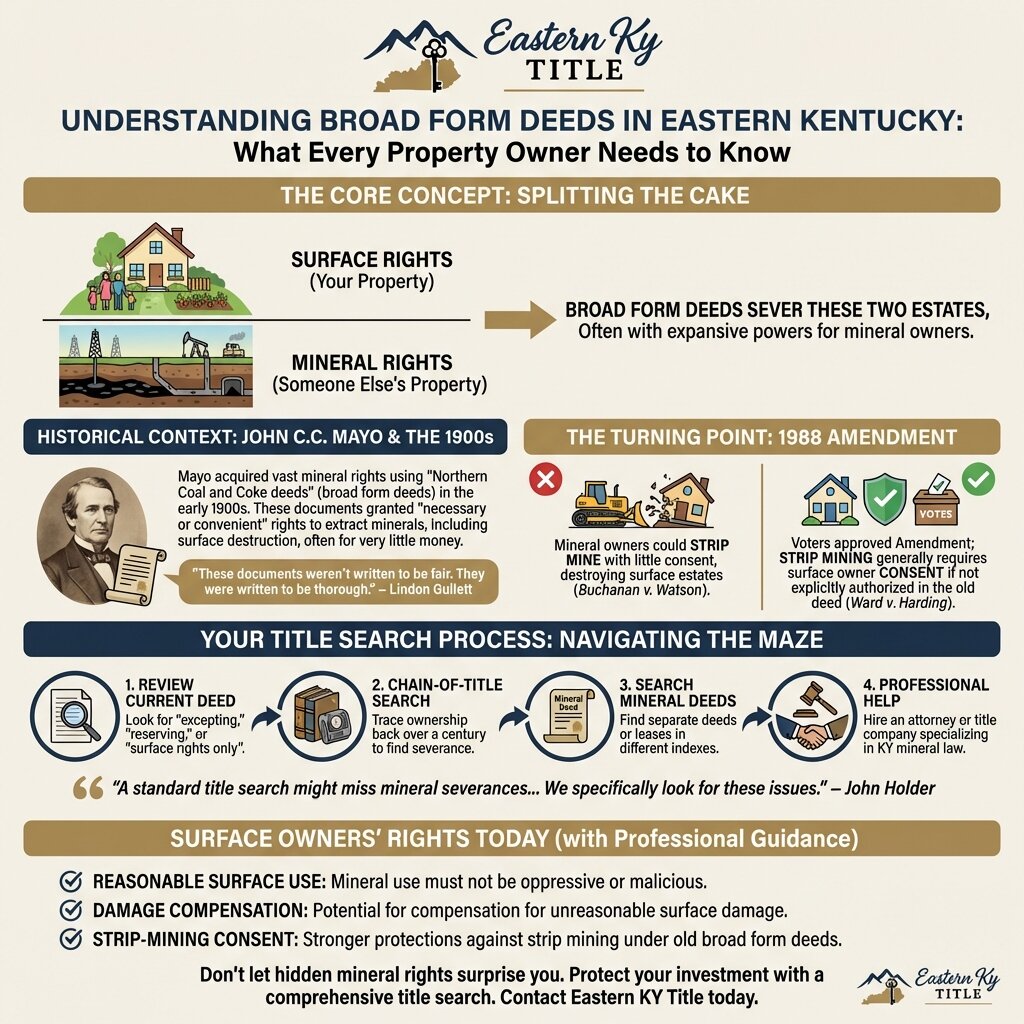
A broad form deed is a specific type of legal document that severs a property into two separate estates: the surface rights and the mineral rights. Think of it like splitting a layer cake. You can own the top layer (the surface where you build your house, grow your garden, and raise your kids), while someone else entirely owns everything underneath (the coal, oil, gas, and other minerals).
What made broad form deeds particularly aggressive was their expansive language. These weren’t polite requests for access. The deeds granted mineral owners the right to do whatever they deemed “necessary or convenient” to extract those minerals, including cutting your timber, diverting your water, and building roads across your land.
As Lindon puts it, “When we pull a title in Floyd or Pike County and see one of these old Mayo deeds, we know we’re in for some homework. These documents weren’t written to be fair. They were written to be thorough.”
When we pull a title in Floyd or Pike County and see one of these old Mayo deeds, we know we’re in for some homework. These documents weren’t written to be fair. They were written to be thorough.
Lindon Gullett
Born in 1864 to a poor Pike County farming family, John C. C. Mayo obtained an education unusual for the mountains—studying at Kentucky Wesleyan College (John’s alma mater!) and working as a teacher—before turning to land and mineral speculation across Eastern Kentucky.
Just in case it’s bugging you to death, the “C. C.” in John C. C. Mayo stands for John Caldwell Calhoun Mayo.
With modest savings and later outside investors, he began systematically acquiring mineral rights, using legal instruments that would shape mineral ownership for the next century.
The most notorious of these instruments, often called the “Northern Coal and Coke deed,” became a template for broad form deeds covering hundreds of thousands of acres and granted mineral owners sweeping rights: to enter and mine, drill for oil and gas, use timber, construct and remove buildings, store materials and waste, and make extensive use of water and the surface with little obligation to compensate the surface owner.
Many families sold their mineral rights for just a few dollars per acre when coal was primarily mined underground. They could not have predicted the future strip-mining technology that would later devastate mountains under those same rights.
For decades, broad form deeds remained relatively dormant. Traditional underground mining disturbed relatively little surface land. But as technology advanced and surface mining became economically viable, the sleeping giant woke up.
In the 1956 case Buchanan v. Watson, the Kentucky Court of Appeals held that owners of mineral rights under a broad form deed could remove coal by strip mining even if doing so destroyed the surface, and that, absent arbitrary, wanton, or malicious conduct, they bore no liability to the surface owner for the resulting damage. This interpretation effectively gave coal companies expansive power to destroy the surface estates of families whose predecessors had signed broad form deeds decades earlier, long before strip mining’s impacts were understood.
Lindon notes, “The human cost of these decisions can’t be overstated. Families watched bulldozers tear through land their ancestors had farmed for generations, and the courts said there was nothing they could do about it.”
Communities organized. Residents from Harlan to Martin County pushed back. And in 1988, over 82% of Kentucky voters said “enough.”
After decades of legal battles and grassroots organizing, Kentucky voters approved the Broad Form Deed Amendment to the state constitution in November 1988. This amendment, now in Section 19(2) of the Kentucky Constitution, fundamentally changed how broad form deeds are interpreted.
The key provision provides that, in deeds where the extraction method is not specifically stated, mineral extraction must be carried out only by methods that were specifically authorized in the deed or reasonably within the contemplation of the parties when the deed was signed. Because modern strip‑mining methods did not exist when most broad form deeds in Eastern Kentucky were executed in the early 1900s, this change has, in practice, meant that companies generally cannot strip mine under those deeds without the surface owner’s consent.
| Situation | Before 1988 | After 1988 |
|---|---|---|
| Strip mining your land | Mineral owner could rely on broad form deeds to strip mine with little or no effective consent from the surface owner. | Strip mining under old broad form deeds generally not allowed unless the deed clearly authorizes it or the surface owner agrees. |
| Underground mining | Still allowed under broad form deeds, typically treated as within the parties’ original contemplation. | Still allowed where consistent with the deed and the parties’ original intent. |
| Oil and gas drilling | Complex rights situation; depended on deed language and evolving case law. | Still complex and fact‑specific; governed by deed language, statute, and post‑amendment case law. |
| Damage compensation | Surface owners often had limited or no recourse for damage from strip mining under broad form deeds. | Better protections; courts construe deeds in favor of preserving the surface estate and allowing damages or blocking methods beyond original intent. |
This is the million‑dollar question, and there’s no real shortcut. Your property deed might contain language that “reserves” or “excepts” the mineral rights, indicating they were separated in a past transaction. But the absence of that language in your current deed does not guarantee you own the minerals.
Here’s the process we recommend:
Look for phrases like “excepting and reserving all mineral rights,” “oil, gas, and minerals excepted,” or “surface rights only.” These are strong indicators that the minerals have been severed from the surface at some point.
This means tracing ownership through the recorded documents at the county clerk’s office to see when, how, and if the mineral rights were severed. In many Eastern Kentucky counties, some of these records go back more than a century, and the key severance may be several links back in the chain.
You or your examiner are looking for a separate document—often called a mineral deed, coal deed, or oil and gas lease—that transferred mineral rights to another party. These documents may be recorded in different indexes or books than standard surface deeds, so they can be easy to miss without a systematic search.
Because of the complexity involved, many property owners hire a title company or an attorney who focuses on Kentucky mineral law to conduct a full examination. A routine “owner’s and encumbrances” search often is not enough to catch older mineral severances.
As John explains, “A standard title search might miss mineral severances, especially in Eastern Kentucky. We specifically look for these issues because we’ve seen too many closings fall apart when someone discovers a mineral reservation at the eleventh hour.”
A standard title search might miss mineral severances, especially in Eastern Kentucky. We specifically look for these issues because we’ve seen too many closings fall apart when someone discovers a mineral reservation at the eleventh hour.
Even if your mineral rights belong to someone else, you’re not powerless. Kentucky law has evolved to provide more balance between surface and mineral owners, especially in how the surface can be used and when strip mining is allowed.
Kentucky treats the mineral estate as generally dominant, but the mineral owner’s use of the surface must be reasonable and cannot be oppressive, arbitrary, wanton, or malicious. In practical terms, if there are reasonable alternatives that allow minerals to be produced without unnecessarily destroying existing homes or improvements, courts can limit extreme or abusive surface uses.
Mineral owners have an implied right to use the surface, but only to the extent reasonably necessary to explore for and produce the minerals. That can include building roads and installing equipment, but their actions cannot exceed what is actually needed for development or be carried out in an oppressive, arbitrary, or malicious way.
Surface owners may be entitled to compensation when mineral operations unreasonably damage the surface—such as roads, timber, crops, or structures—or when the operator exceeds the rights granted in the deed. These damage issues are often negotiated in leases or agreements, but they can be litigated when the parties disagree about whether the operator’s conduct was reasonable or within the deed.
Under Kentucky’s 1988 Broad Form Deed Amendment and the Kentucky Supreme Court’s decision in Ward v. Harding, coal companies generally cannot strip mine under pre‑1984 broad‑form deeds that do not specifically authorize surface mining unless the surface owner consents. This is because modern strip‑mining methods were not considered to be within the parties’ original contemplation when most of those deeds were signed.
Standard title insurance policies often include exceptions for mineral rights. This means if a mining company shows up claiming rights under an old broad form deed, your basic policy might not cover you.
In Eastern Kentucky, we recommend:
Enhanced Title Searches: Go beyond the standard 20-year search. Mineral severances often occurred 80-100+ years ago and won’t appear in a routine examination.
Mineral Rights Verification: Specifically request that your title search include mineral rights verification. Not all title companies do this automatically.
Owner’s Title Insurance: While lenders require their own policy, an owner’s policy protects your investment. Some enhanced policies offer coverage for mineral rights issues.
Clear Documentation: Get everything in writing about what minerals were searched and what exceptions apply.
Lindon often tells clients, “Title insurance is your safety net. In coal country, that net needs to be stronger than average.”
Title insurance is your safety net. In coal country, that net needs to be stronger than average.
After handling thousands of transactions involving mineral rights, we’ve identified patterns that frequently cause problems:
Heir Property Complications: When mineral rights pass through multiple generations without clear documentation, ownership can become fractured among dozens of heirs. One property we examined had mineral rights split among over 40 different parties.
Dormant Mineral Rights: Sometimes mineral rights haven’t been exercised in decades. Owners assume they’ve lapsed, but Kentucky law doesn’t provide for automatic abandonment of mineral rights.
Oil and Gas Leases: Even if you own surface rights, existing oil and gas leases may grant access rights to energy companies. These leases need to be identified and understood before closing.
Tax Sale Issues: If mineral rights owners fail to pay property taxes, those rights can be sold at tax sales to new parties, further complicating ownership.
Boundary Disputes: Old surveys didn’t have GPS precision. Mineral boundaries sometimes conflict with surface boundaries, creating additional title issues.
Buying property where the minerals have been severed isn’t necessarily a deal-breaker, but it requires extra due diligence.
As we often say, better to uncover these issues before closing than after.
Selling property with unclear mineral status can delay closings and reduce your sales price. Clarifying things up front helps keep the deal on track.
Title insurance in Kentucky commonly falls in the 0.5%–1.0% range of the home’s purchase price. For a $200,000 property, expect to pay approximately $1,000 to $2,000. Enhanced coverage for mineral rights issues may cost additional fees. Kentucky follows standardized rates set by title underwriters and rates are regulated, so premiums are relatively consistent across providers.
A basic owner‑and‑encumbrance search can be turned around in a few days, but full exam timelines like 5–10 business days are common, especially when pulling older records across multiple books. Properties with complex mineral histories, older chains, multiple heirship transfers, or limited digitized records can reasonably take 2–4 weeks for a thorough search and curative work, which matches your description.
Owner’s title insurance is not legally required in Kentucky, but it is widely recommended for both financed and cash purchases because it protects the owner against hidden defects in title, not just the lender. In areas with complex mineral and heirship issues, like Eastern Kentucky, going without an owner’s policy significantly increases the risk that an old lien, mineral reservation, or boundary problem will become the buyer’s problem after closing.
Kentucky law does not provide a broad, automatic ‘dormant mineral’ statute that extinguishes unused severed mineral rights after a set number of years, so older severed interests often remain in place indefinitely unless conveyed or otherwise cleared. However, particular mineral interests can be lost or transferred through mechanisms such as tax sales or the expiration of leases according to their terms, so each situation needs to be evaluated individually.
This depends on what representations were made during the sale and whether title insurance was purchased. If the seller misrepresented mineral ownership, you may have legal recourse. If you have title insurance, check whether your policy covers the issue. Consult with a Kentucky real estate attorney to understand your options.
Sometimes. If you can identify the current mineral rights owner, you may be able to negotiate a purchase. However, mineral rights are often held by corporations or split among numerous heirs, making acquisition difficult or impossible. A title search can help identify who to contact.
A broad form deed is a specific type of mineral deed characterized by expansive language granting the mineral owner extensive rights to use the surface. Regular mineral deeds may convey only the minerals themselves with implied or limited surface access rights. The broad form deed’s aggressive language created the controversies that led to the 1988 Amendment.
The Amendment applies to instruments that sever or grant coal interests but do not specify the method of extraction in clear, specific terms or that broadly subordinate the surface. If a deed explicitly authorizes strip mining or surface mining, the Amendment may offer less protection, and each deed must be evaluated individually.
Not exactly. While both are mineral rights that can be severed from surface ownership, oil and gas development has different legal considerations. The broad form deed controversy primarily centered on coal mining, though many broad form deeds also conveyed oil and gas rights. Oil and gas drilling involves different surface disturbance patterns and different regulatory frameworks.
This requires careful evaluation of existing leases, access agreements, and development plans. You’ll want to understand: What areas are affected? What compensation is the surface owner receiving? What are the remaining development rights? These factors significantly impact property value and usability.
Our team combines legal expertise, local knowledge, and a commitment to client protection. Led by Market President John Holder and President Lindon Gullett (both licensed Kentucky attorneys), we deliver secure, accurate, and stress-free real estate closings for families, lenders, and real estate professionals across Eastern Kentucky.
Our Team:
Professional Credentials:
Whether you’re buying, selling, or just want to understand what rights you actually own, a comprehensive title search is your first step toward peace of mind. In Eastern Kentucky, where a century of mineral severances can complicate even simple transactions, working with a title company that knows these specific challenges makes all the difference.
Call and schedule a free consultation with Eastern KY Title. We’ll review your situation, explain your options, and make sure you understand exactly what you’re buying or selling. No surprises. No last-minute title problems. Just smooth, stress-free closings backed by Stewart Title and over 50 years of combined legal experience.
Contact us today to discuss your property and protect your investment.
Best regards, Eastern KY Title Team
