Address
234 Lower Gilmore Rd
Campton KY 41301
Work Hours
Monday to Friday: 9AM - 5PM

Address
234 Lower Gilmore Rd
Campton KY 41301
Work Hours
Monday to Friday: 9AM - 5PM


TL;DR: Transferring property after a death in Eastern Kentucky is rarely as simple as signing a few papers. Between heir property disputes, severed mineral rights, and outdated deeds, families can spend months – sometimes years – untangling what should be a straightforward inheritance. This guide explains how estate planning and proper property transfer protects your family, your land, and your legacy before it becomes a courthouse battle.
I’ve sat across kitchen tables in Lewis County, Boyd County, Rowan County, and everywhere in between, and I’ve heard the same story more times than I can count.
Dad passed. Mom wants to sell the house and move closer to her grandkids. The realtor is ready. The buyer is ready. And then somebody pulls the deed.
Turns out Grandpa never changed ownership when he bought out his brother back in 1987. Or there’s a coal severance from 1923 that wasn’t disclosed. Or three cousins in Ohio technically own a third of the property because nobody ever handled the estate after Uncle Raymond died.
Suddenly a two-week closing turns into a six-month title nightmare. The buyer walks. The realtor loses the deal. And your grieving family is now spending money on attorneys instead of moving forward.
This is the cost of not planning. And in Eastern Kentucky, where land has changed hands through handshakes, oral agreements, and hastily drawn deeds for generations, the title problems that surface during estate transfers can be genuinely complicated. The good news? Most of them are preventable – or at least manageable – if you know what you’re dealing with ahead of time.
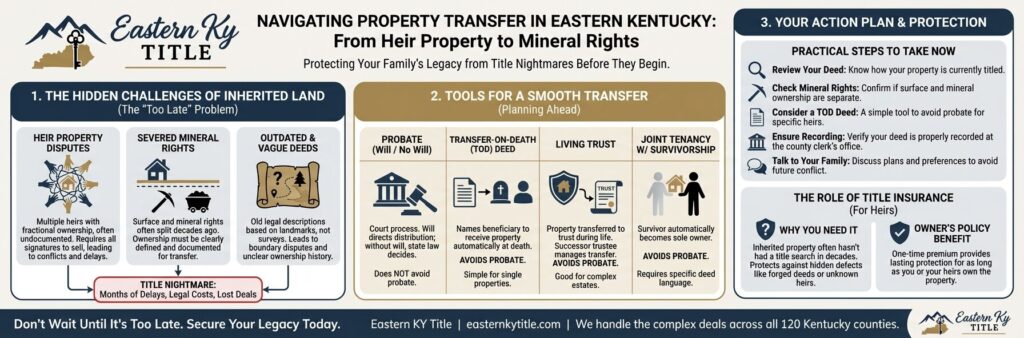
In simple terms, estate planning is deciding what happens to your stuff – including your real estate – when you die or become unable to manage it yourself. Property transfer is the legal process that actually moves ownership from one person (or estate) to another.
In Kentucky, when someone dies, their real property doesn’t automatically jump to the next logical person. It goes through either probate (the court process for distributing assets under a will, or without one) or it transfers directly if the ownership was set up correctly in advance through tools like a transfer-on-death deed, a living trust, or joint tenancy with right of survivorship.
That “if set up correctly in advance” part is where most Eastern Kentucky families run into trouble. Because for decades, the prevailing philosophy around here was “we’ll figure it out when the time comes.” And when the time comes, it’s rarely convenient.
I’m not saying this to be dramatic – Eastern Kentucky has some of the most genuinely complex title histories in the country. There are a few reasons for that.
Kentucky coal country has a long history of mineral rights being separated from surface rights, sometimes over a hundred years ago. A family can own the house and the land outright, but the coal, oil, or gas beneath it was sold off generations back. When you go to transfer the property, those severances have to be identified and documented correctly, or you risk a buyer – or their lender – getting cold feet.
This one comes up constantly. A family member dies without a will, the family agrees on who should have the house, and everyone just… moves in. Years pass. Decades pass. The person living there pays the taxes. But legally? Every heir of the deceased has a fractional interest in that property.
When it’s time to sell, you need signatures from every one of those heirs – including people who may have moved away, lost touch, or died themselves, creating another layer of heirs. I’ve worked cases where we had to track down family members across four states to get a clean chain of title. It’s doable. But it takes time and it takes someone who knows what they’re looking at.
Before GPS and survey technology, deeds in Eastern Kentucky were written using language like “beginning at a white oak tree on the ridge above the holler, running northeast to the old fence post, thence…” You can imagine how well that holds up today. Boundary disputes are common, and they have to be resolved before a property can transfer cleanly.
In rural Kentucky, it wasn’t unusual for property to change hands with nothing more than a recorded deed at the courthouse – or sometimes not even that. If a deed was never recorded, or was recorded improperly, it creates a gap in the chain of title that has to be addressed.
There are several ways property can transfer in Kentucky at death. Understanding which option fits your situation is the first step toward a plan that actually works.
Probate: If someone dies with a will, their estate goes through probate in the county where they lived. The executor named in the will manages the process, debts are paid, and property is distributed according to the will’s terms. If there’s no will, Kentucky’s intestate succession laws determine who gets what – which may or may not match what the family expected.
Transfer-on-Death (TOD) Deed: Kentucky allows property owners to record a deed that names who receives the property when they die, without going through probate. The property stays in the owner’s name during their lifetime; the transfer happens automatically at death. This is one of the cleanest tools available, and it’s still underused.
Living Trust: Property transferred into a properly funded revocable living trust avoids probate entirely. The successor trustee manages the transfer according to the trust’s terms. More complex to set up, but highly effective for larger estates or situations with multiple properties.
Joint Tenancy with Right of Survivorship: When two people own property this way, the survivor automatically becomes the sole owner when the other dies – no probate required. This requires specific language in the deed, and not every deed that seems to convey joint ownership actually creates the right of survivorship under Kentucky law.
As Lindon puts it: “What people really want is to hand this land to the next generation without handing them a legal mess. The right tools exist. The problem is most families don’t know to ask about them until they’re already in the mess.”
What people really want is to hand this land to the next generation without handing them a legal mess. The right tools exist. The problem is most families don’t know to ask about them until they’re already in the mess.
Lindon Gullett
Let me paint a picture that I see play out regularly across Eastern and Central Kentucky.
A family owns 40 acres in Pike County. The patriarch bought it in 1968, built the house himself. He dies in 2005 without a will. His wife stays on the property, pays the taxes, never thinks much about it. She dies in 2019. Now the property technically belongs to their six children in equal shares – two of whom have also passed away, leaving their own spouses and children as heirs.
A developer comes along in 2024 and wants to buy the timber rights. The family says yes, but to get the title clear, they need signatures from every living heir – which now includes approximately fourteen people scattered across three states. Several of them don’t even know this land exists.
That’s a real scenario. Not that exact case, obviously, but I’ve seen variations of it more times than I’d like. And what makes it painful is that it’s almost always avoidable with a little upfront planning.

When you transfer property – whether through a sale, an inheritance, or a gift – title insurance protects against defects in the title that weren’t discovered during the search. That includes things like forged deeds, undiscovered heirs, recording errors, and prior liens.
Eastern KY Title partners with Stewart Title for our abstracting work, which means we have access to one of the most respected underwriters in the industry backing our closings. For estate transfers, that backing matters because the complexity of Eastern Kentucky titles means the margin for error is real.
Owner’s title insurance, in particular, is often worth every penny on inherited property. Because unlike a traditional purchase where a title company searched the property recently, inherited property may not have had a formal title examination in decades – or ever. An heir’s policy protects against exactly the kind of problems that surface later.
You don’t have to have a complicated estate to need a plan. If you own real property in Kentucky, here are the practical steps that make a meaningful difference.
Get the deed in front of an attorney. Know exactly how your property is titled right now. Joint tenancy? Tenancy in common? Sole ownership? That determines what happens at death.
Check for mineral severances. Especially in Eastern Kentucky, the surface and mineral ownership may be different people. Know what you actually own before you plan.
Consider a transfer-on-death deed. If you want a specific person to inherit your real estate without going through probate, this is often the most straightforward path in Kentucky.
Make sure your deed is recorded. Sounds basic, but unrecorded deeds are more common than you’d think, especially with older transactions.
Talk to your family now. Not a fun conversation, but considerably less painful than the alternative. If you have preferences about who gets the property, get it in writing legally. Handshake agreements and verbal promises don’t survive probate.
| Method | Avoids Probate | Requires Attorney | Best For |
|---|---|---|---|
| Probate (will) | No | Recommended | General estate distribution |
| Probate (no will) | No | Recommended | Intestate situations |
| Transfer-on-Death Deed | Yes | Recommended | Single real property, simple transfer |
| Living Trust | Yes | Yes | Multiple properties, larger estates |
| Joint Tenancy w/ ROS | Yes | For deed drafting | Couples, co-owners |
Before you list that inherited property, or try to transfer it to a family member, watch for these red flags:
Any of these situations warrants a title examination before you get too far down the road.
You can quickly find answers to the most common questions about estate planning and property transfer. If you can’t find what you’re looking for here, please contact us.
Owner’s title insurance in Kentucky is typically a one-time premium calculated as a percentage of the property’s purchase price or value. For most residential properties in Eastern Kentucky, expect to pay between $300 and $800 depending on the property value and complexity of the title history. It’s a one-time cost for protection that lasts as long as you or your heirs own the property.
Yes, possibly more so. When you purchase property, the title company searches recent history. With inherited property, the chain of title may have decades of exposure. An heir’s title policy covers defects that may surface later – including claims from unknown heirs or errors in probate proceedings. It’s worth discussing with your title agent before you assume you’re covered.
Yes. A transfer-on-death deed or a properly structured living trust can accomplish this. Some parents also deed property to children while retaining a life estate, which allows them to continue living there. Each approach has different implications for taxes, Medicaid eligibility, and the children’s cost basis in the property. Talk to an attorney before deciding which path fits your situation.
Kentucky does recognize holographic wills – wills written entirely in the testator’s own handwriting and signed – without requiring witnesses. However, they’re often challenged and can create significant problems if they’re unclear or don’t address all property. A properly drafted will with witnesses is far more reliable, especially when real property is involved.
A standard title search takes 3 to 5 business days for straightforward residential properties. For properties with complex title histories – common in Eastern Kentucky due to heir property situations, mineral severances, and older deeds – it can take 2 to 4 weeks or longer. If we find problems that need to be resolved before closing, that timeline extends further.
Heir property is real estate that passes informally through a family – often through intestate succession without a will – and is never formally transferred into the heirs’ names. The family lives on it, pays taxes on it, and treats it as “theirs,” but legally, every heir of the original owner has an interest. Heir property can be difficult to sell, refinance, or transfer cleanly without a court proceeding to quiet title.
The surface and mineral ownership transfer separately. If you own the surface but not the minerals, you can still sell or transfer the surface. The deed should clearly reflect what’s being conveyed – surface only, or surface with any remaining mineral interests. Failing to address this properly can create confusion for the buyer and their lender.
Title searches are conducted at the county clerk’s office in the county where the property is located. In Kentucky, that means you’d search the deed books and judgment liens at the local courthouse. For properties near county lines or with a complex history, searches in multiple counties may be necessary.
If you own real estate in Eastern Kentucky, your family deserves a clear plan. Not because something’s wrong, but because land matters here – and the last thing you want is to leave your kids with a title problem instead of a inheritance.
The title issues we see most often aren’t caused by bad people or bad intentions. They’re caused by time, informality, and the very human tendency to put off uncomfortable conversations. A little planning now – a reviewed deed, a transfer-on-death deed recorded at the courthouse, a conversation with an attorney about what you actually own – can prevent months of legal work and thousands of dollars in costs later.
We do this work every day across all 120 Kentucky counties. We handle the deals that other title companies decline. And we’ll come to you – your kitchen table, your office, your front porch – because that’s how we work.
About the Author
John Holder, Attorney at Law (Licensed in Kentucky), is Market President & Title Agent at Eastern KY Title. With over 30 years of legal experience and thousands of closings completed as a loan signing agent, John leads operations with a legal-first approach built on experience in real estate law, business development, and risk mitigation. He’s known for simplifying complex transactions and his commitment to digital security and client education. John is also the founder of Kentucky Notaries and author of “Kentucky Notary Law & Practice: A Modern Guide.”
Professional Licensure & Credentials:
If you’re dealing with an inherited property, planning for the future, or just trying to understand what you actually own, we’re here to help. Call us directly, or fill out our contact form and we’ll get back to you fast. No runaround, no corporate phone tree – you’ll talk to someone who knows Eastern Kentucky property law.
Call Eastern KY Title today or visit meet.easternkytitle.com to schedule your consultation.
Best regards, Eastern KY Title Team
FULL DISCLOSURE: We use AI to draft our blog content because, frankly, we’d rather spend our time closing deals and helping Kentucky realtors than staring at blank screens. But don’t worry, we’re not letting the robots run wild. John and Lindon edit every single post to make sure it’s factually accurate, Kentucky-specific, and doesn’t sound like it was written by someone who thinks Appalachia is a type of pasta. If the AI writes something dumb, we fix it. If you spot something we missed, call us out. We’re good for it.
